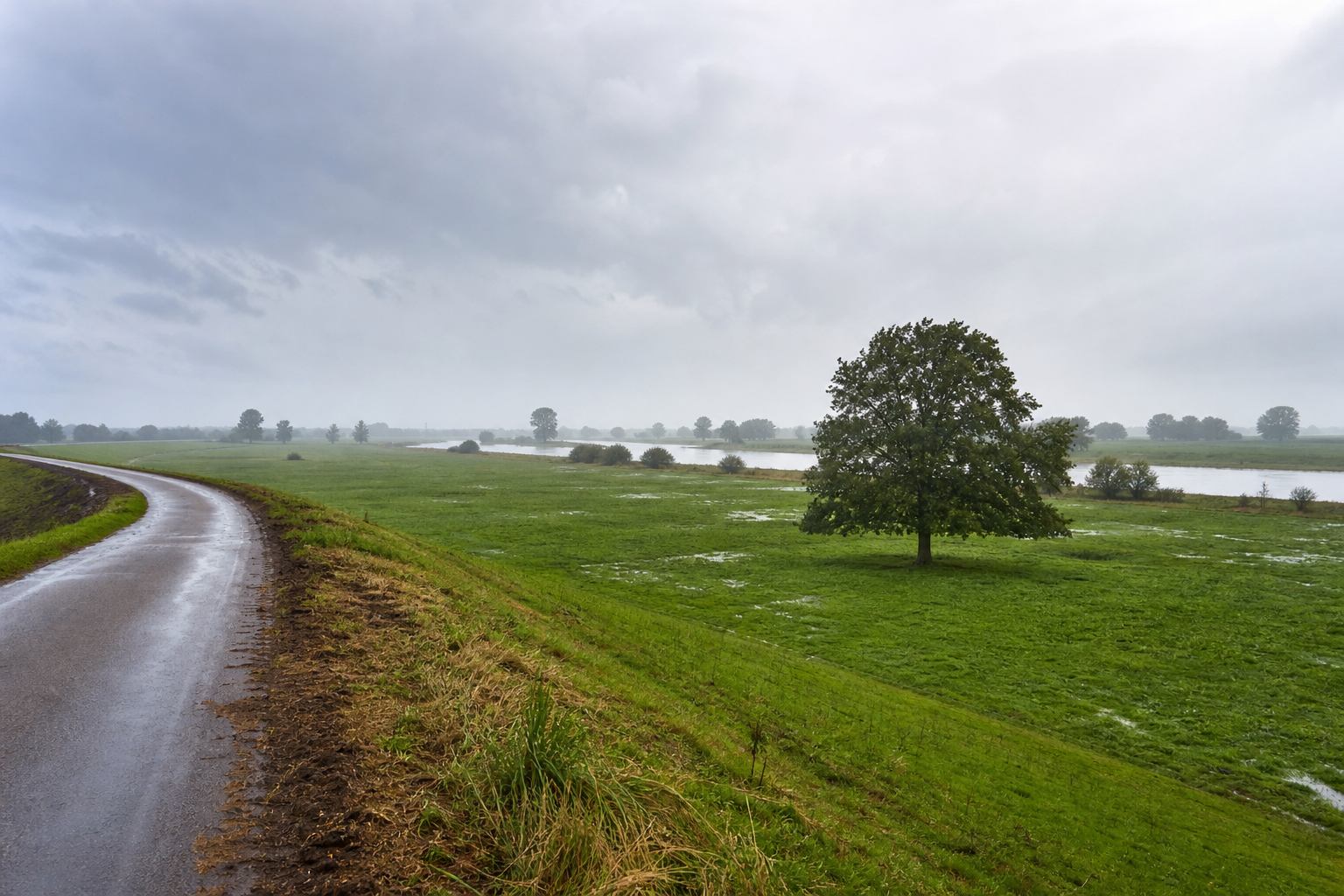
Flood meadows · Nienburg · Petershagen
Green rooms the river keeps rewriting
Along the Weser the landscape is not a lake plate. It is a corridor: current, dike, meadow, a town that still faces the water, then meadow again.
Nienburg as a river gate, not a museum stop
Nienburg sits where trains, road and river agree on a crossing. That is why it belongs in a landscape notebook. Timbered streets exist; they are secondary. The useful facts are the station, the access to the Weser cycle path, and the way the town thins into water meadows within a few minutes. You can buy bread, step onto the bank, and be in wind again.
Petershagen, further along the valley, keeps the same grammar with a quieter volume: lock, meadow, brick, bicycles leaning on a rail, then the river as a moving silver. Architecture remains a rim. The centre of the picture is the floodplain — grass that can go under water and still be a path on the dike the next week.
How a flood meadow works for a walker
A flood meadow is a bargain between river and farm. When levels rise, the grass room takes the water so the town stays dry. When it falls, you get a green expanse with ditches, cattle, and a single oak that has learned to stand in wet ground. Your job is to stay on the crown of the dike or the signed farm track. The interior grass is not a park lawn.
May is the loud green. After a wet spring the meadows look almost fluorescent against a pewter river. July is longer light and easier cycling. September bronze belongs more to the lakes, but the Weser still holds herons and the smell of wet earth. Pair a river day with Steinhuder Meer if you want still water after moving water, or with Rehburg’s oak islands if you want shade after glare.
Trains as part of the landscape
The Weser valley is one of the few places in this notebook where public transport feels native rather than a shuttle to a car park. Regional services along the Hanover–Bremen axis put Nienburg on a real timetable. That lets you ride downstream and return by rail, or the reverse, without closing a loop for its own sake. It is the opposite of a closed lake circuit, and that is the pedagogical point of day four in the five-day route.
Practical kit is honest: windbreaker, rain shell, shoes that accept mud, water, and an offline map because farm tracks fork without drama. Binoculars still earn their weight — not for a sea of geese, but for a kingfisher as a brief electric line, or a heron pretending to be a fence post. Summer rain on the Weser is a feature. The meadow goes darker, the river paler, and the sky does the interesting work. See also the Weser meadow ride distances and the season notes for when the grass is a nursery rather than a thoroughfare.
- Arrive by regional train; do not start with a ring-road search for parking.
- Walk or ride the dike first; drop to the water only where the path allows.
- Use the town for bread and weather, then return to the green room.
- Finish before dusk if the meadow ditches are full — the extra beauty is not worth a wrong step.
The river is a method
Once you can read a floodplain, the lake loops make more sense: one is a closed silver plate, the other is a moving corridor. Both belong in the same northern notebook.
Place this day in the five-day line